
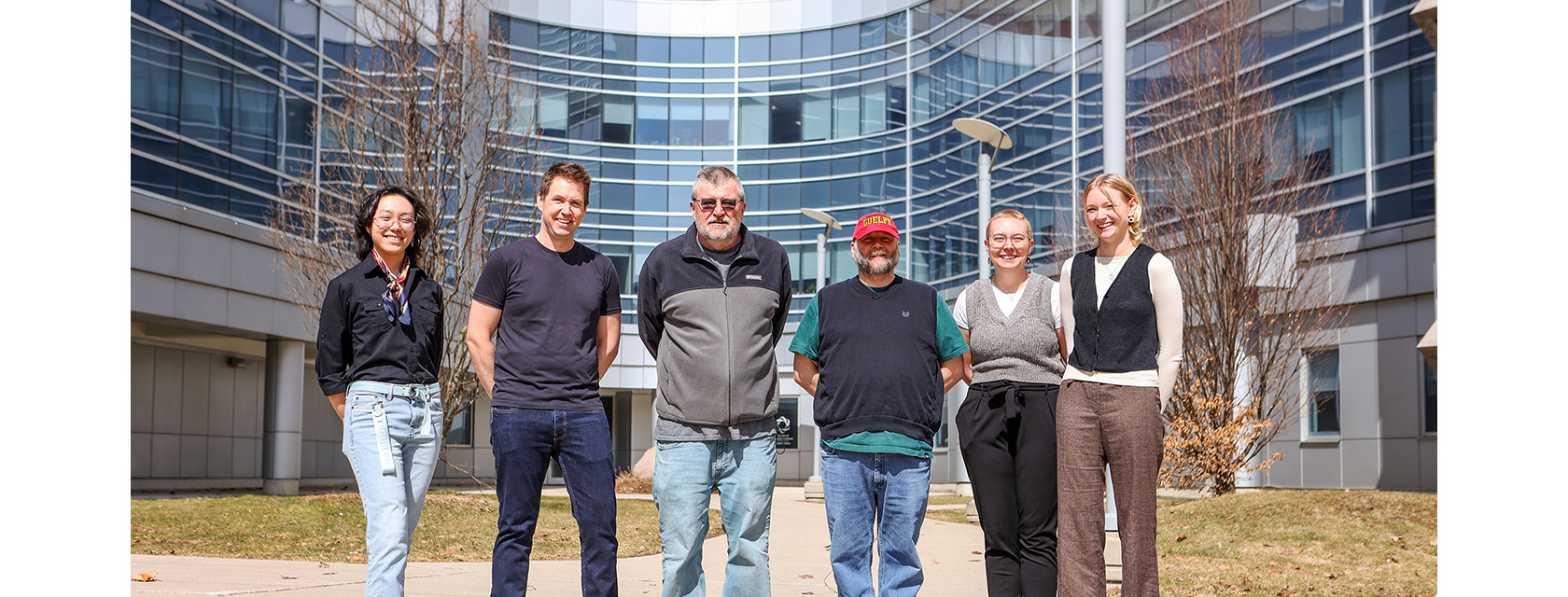
Curiosity rover instrument developed by Dr. Ralf Gellert helps decode another piece of the planet’s geological history
When NASA’s Curiosity rover recently discovered the first known deposit of pure sulfur on Mars, it was thanks to an instrument designed by a University of Guelph physics professor.
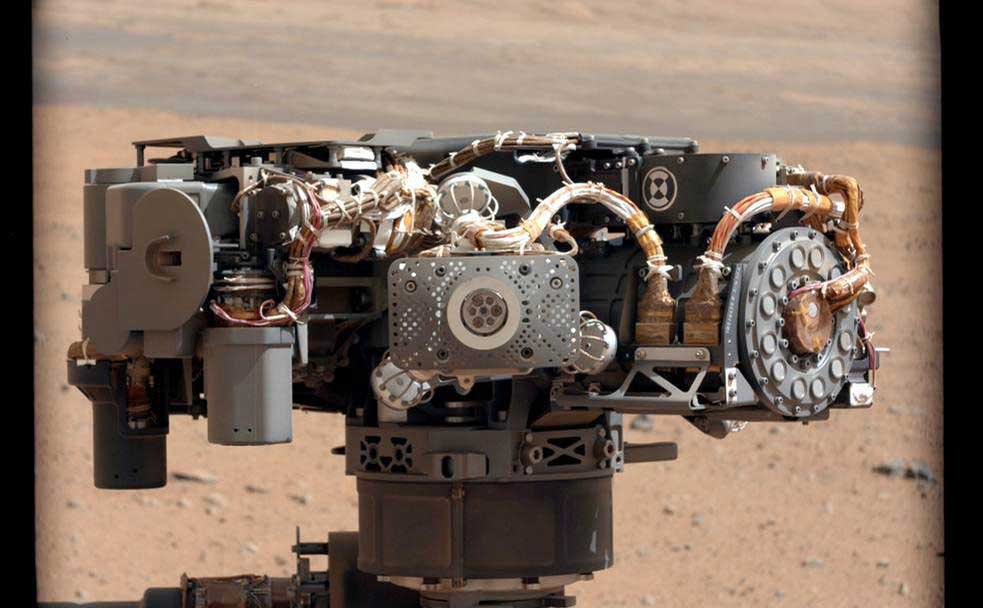
Dr. Ralf Gellert is the principal investigator for the Alpha Particle X-Ray Spectrometer (APXS), a mobile geochemistry lab on board the rover that analyzes the chemical composition of Martian rocks and soils.
Gellert helped design the instrument two decades ago, and it has gone on to become the Canadian Space Agency’s key contribution to the ongoing mission.
Gellert still oversees the operation of the device. A team of post-doctoral researchers in the Department of Physics share responsibility for the instrument’s daily activities with collaborators at other institutions, fully supported by the Canadian Space Agency.
“For over a decade, we have been operating this instrument just a few rooms down from the physics lecture hall, where we connect with servers at NASA and discuss with the rover team what the rover should do the next day,” he says.
“That’s rather unique, since most of the other teams are stationed at big institutions like NASA centres, usually behind barbed wires.”
Unexpected discovery in Martian crater
In 2024, while the Curiosity rover travelled through a valley that geologists believe was carved billions of years ago by water, the rover encountered a large field of whitish rocks.
Gellert’s team was asked to deploy the tin-can-sized APXS mounted on the end of Curiosity’s robotic arm to investigate. Bombarding the rock with alpha particles and X-rays, the APXS measured the radiation emitted in response. When the data came down, Gellert immediately knew they had found something new.
“I analyzed the spectrum and realized there was so much signal of sulfur that the usual assignment as SO3 did not make sense here for the first time,” he remembers.
He quickly found three clear signs in the APXS data and posted: “Near pure elemental sulfur, who knew!” to the NASA servers.
Meanwhile, the rover had crushed open one of the other bright rocks and exposed the characteristic yellowish-green crystals —a visible telltale sign for native sulfur— confirming the finding.
Why is there sulfur on Mars?
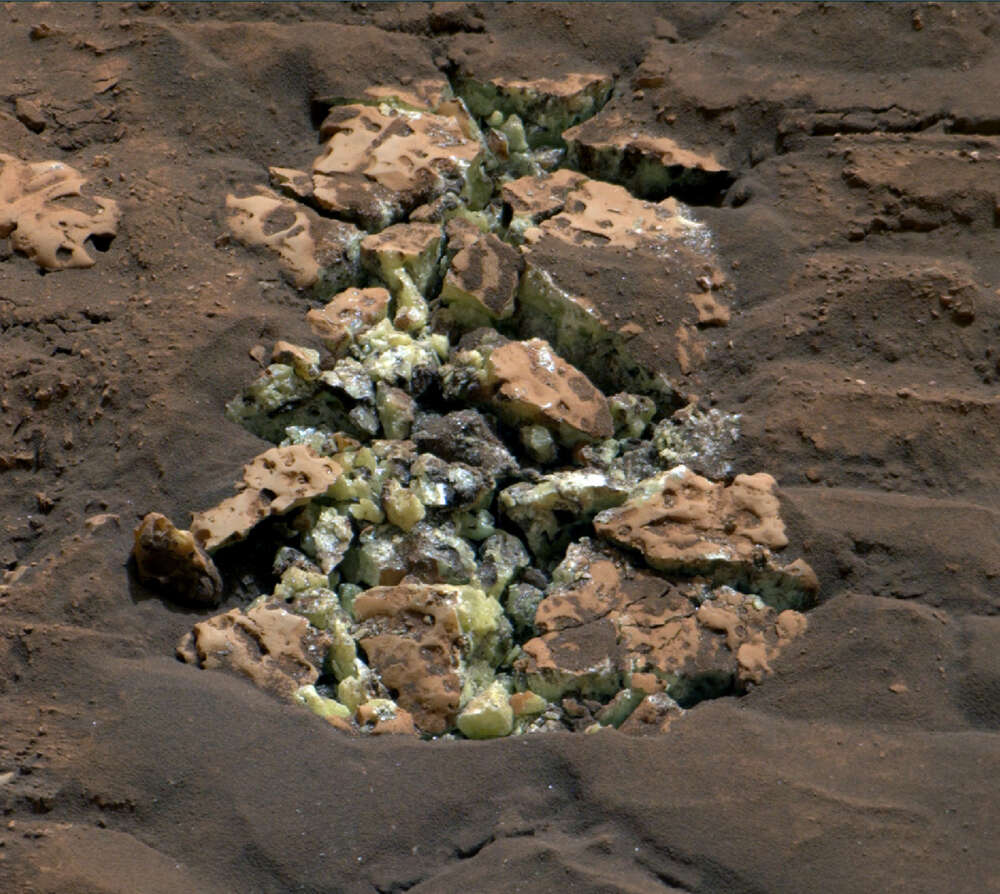
Scientists already suspected Mars had once been rich in sulfur, but it had only ever been discovered in sulfate or sulfide form, meaning it was chemically bound to oxygen and other elements.
The earlier APXS instruments on the rovers Spirit and Opportunity had found lots of sulfates, which were signs of an interaction with water in the past. Finding a field of rocks made of pure, native sulfur in that area came as a happy surprise to NASA scientists, since it indicated that the environmental conditions on Mars had changed in the past.
Gellert admits he didn’t fully understand the significance of what he helped to investigate that day. “I am a physicist, not a geologist,” he says. “To interpret our results, we have many geologists on the team who quickly started to dig into this solid finding.”
A research team has now proposed an explanation in a paper that was co-authored by Gellert and published last month in a cover article in the journal Science.
They suggest the sulfur originated in subsurface ice billions of years ago and later formed deposits that were trapped by avalanche debris from a large mountain at the centre of the massive crater that Curiosity had been investigating. Over time, those sulfur-bound rocks were re-exposed through Martian wind erosion.
APXS generating important space research findings
The APXS has been a crucial part of NASA’s Mars Science Laboratory mission and on the previous three rovers. Since Curiosity landed in 2012, the APXS has analyzed 1,761 samples and sent nearly 4,000 results back to Earth, according to the Canadian Space Agency.
The lead author of the Science paper is Dr. Scott VanBommel, a U of G alumnus who is now a research professor at Washington University in St. Louis. VanBommel completed both his undergraduate and graduate studies in physics under Gellert’s supervision at U of G, where he developed a deep love for space science.
“This is a good example of the unique kind of experience we can give students in the physics department: the chance to work on data from a different planet,” Gellert says. “Even though it’s on a different planet, it’s still science. It’s not black magic, it’s simple, pure science.”