

This story was produced by The Globe and Mail Content Studio with the University of Guelph as part of a paid content partnership and originally appeared in The Globe and Mail.
Coming soon to a grocery store shelf near you: superbean, the world’s first bean designed with the help of artificial intelligence.
It’s likely a few years off from wide commercial availability – and the name might change before it hits the market – but Dr. Mohsen Yoosefzadeh Najafabadi, assistant professor and lead for dry bean breeding and computational biology at the University of Guelph, is enthusiastic about the results so far.
“It’s very promising,” he says.
Superbean – which will be a dry bean similar to navy, black or kidney beans – was developed using BeanGPT, an AI tool that Dr. Yoosefzadeh Najafabadi built by inputting over 300,000 research papers, and 50 million data points about everything from climate change to agronomics and news reports. In combination with another app he built called Bean Memory, trained on 40 years of U of G’s archives, he asked the AI to give him ideas for breeding a bean that was high in protein, but also high-yielding and disease resistant.
Dr. Yoosefzadeh Najafabadi was initially sceptical – after all, new bean breeds can take over a decade to develop – but gave AI’s suggestions a try.
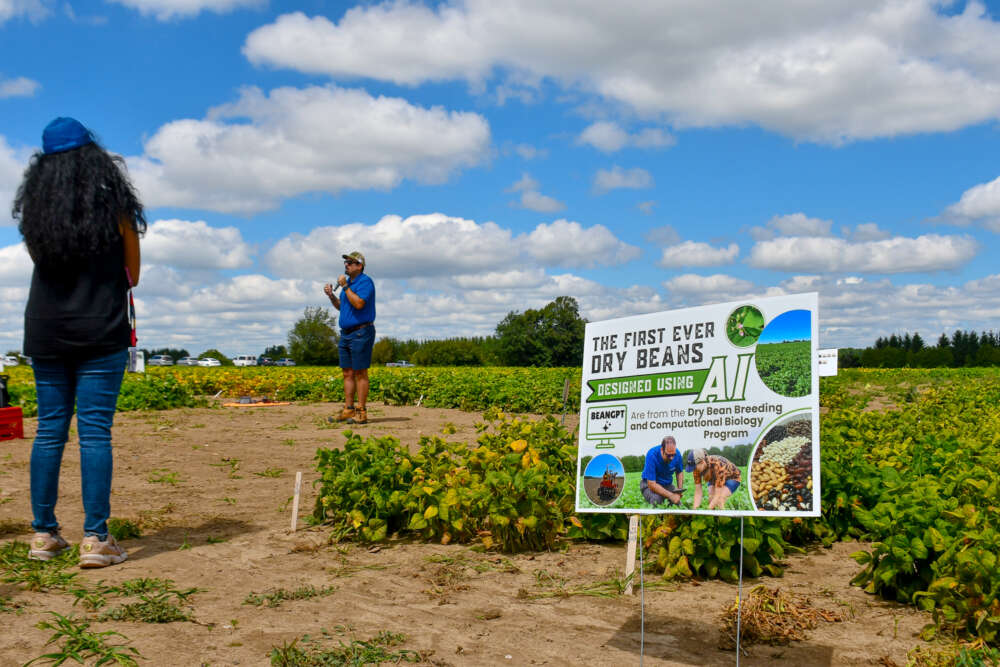
This summer, he was thrilled to discover that, despite heat waves and wildfire smoke, these new “superbean” varieties were performing very well, on par with the varieties they were testing out based on old-fashioned human logic.
It’s been very busy in Dr. Yoosefzadeh Najafabadi’s lab lately: Although the university has a long history of exceptional bean development – for example, soybean varieties developed at U of G account for half of Ontario’s food-grade soybean production – the world’s current obsession with getting more protein is driving demand for their research expertise.
“Beans are the practical way to put plant protein and fibre on the plate,” says Dr. Yoosefzadeh Najafabadi, whose lab is also working on small-seeded bean varieties that can cook in 30 minutes with no pre-soaking required.
Meeting the demand with innovation

Demand for protein is on the rise. Just walk the aisles of any grocery store, and you’ll be greeted with a plethora of high protein products, ranging from bars to popcorn to drinks. A recent Leger survey of Canadians and Americans found that as more people take GLP-1 weight loss drugs, many are eating more protein to prevent muscle loss.
“Clearly, global demand for protein is going up,” says Dr. Mike von Massow, a professor at the Ontario Agricultural College at U of G. He points to two factors influencing that demand: rising income leading to rising protein consumption in emerging economies, and the simple fact that protein is “really cool right now,” with consumers looking for new ways to hit their daily goal.
He adds that beans are well-suited to Ontario’s climate, making the need for more efficient, higher-yielding varieties particularly urgent in this moment of international potential. And researchers at the University of Guelph are proud to be helping Canadian farmers meet that moment.
“[Innovation] creates higher returns for farmers, which helps sustain rural communities,” says Dr. von Massow. “There’s also some real pride in contributing to food security across the world.”
Genetics to breed healthier cows
And it’s not just beans: Experts across disciplines at the University of Guelph are working hard to strengthen Canadian farms and food production as they export protein products around the world – from soy to dairy to meat and fish.

“One of U of G’s superpowers is that our research spans the entire protein value chain. We do research on soil and water to genetics, food processing, nutrition and international markets,” says Dr. Christine Baes, a geneticist and professor at the Ontario Agricultural College. “We work with animal-, aquaculture-, and plant-based proteins, as well as emerging technologies like cellular agriculture and pretty much everything in between. This research has direct implications for farmers and ultimately, for all Canadians.”
Much of that research is driven through the Ontario Agri-Food Innovation Alliance, a collaboration among the University of Guelph, Government of Ontario and the agri-food industry.
Dr. Baes says the opportunity for producers is to meet growing demand while continuing to strengthen the sustainability of production. One of the ways U of G is working on improving sustainability is its Net-Zero Dairy Genome Project, where it’s using genetics to breed healthier, more efficient cows that produce less methane.
“Canadian dairy farmers already have tools to select for lower methane emissions, and because genetic improvements accumulate over generations, the benefits are long-lasting,” she says.
The Net-Zero Dairy Genome Project is one example of how U of G researchers are turning scientific advances into practical tools for Canadian producers. That impact extends across the protein sector. Crosby Devitt, CEO of Grain Farmers of Ontario, sees this impact every day, particularly when it comes to U of G’s innovation in soybeans.
“It’s absolutely huge that we have the tools to grow better soybeans,” Mr. Devitt says. He notes that access to the right type of soybean – like the varieties developed in U of G’s labs – is crucial in a market that’s increasingly in search of high-quality beans suited to specific products like tofu, miso and soy milk.
“That can be a really valuable part of a farmer’s crop,” he says.
The growing demand for protein is driving investment and job creation across Ontario’s agri-food sector. The recent opening of Alinova Canada’s soymilk processing plant in Morrisburg, Ont., allows more Ontario-grown soybeans to be processed here at home, supporting rural jobs and helping farmers capture greater value through lower transportation costs and reduced exposure to cross-border tariffs.
Getting research to the plate
Meeting the growing demand for protein means increasing supply sustainably.
University of Guelph researchers are working on ways to improve beef production, a protein staple for many, from genetics to optimizing feed formulas to preventing disease.
A recent study looked at the benefits of continuous versus rotational cattle grazing systems. In a continuous system, cattle have access to the entire grazing area all season, while rotational grazing divides pastures into smaller paddocks with cattle moved at regular intervals. Early results showed that rotational grazing may have the potential to enhance animal performance – help them gain more weight – without increasing methane production.
Richard Horne, executive director of Beef Farmers of Ontario, says that beef farmers are proud to partner with the university because they have confidence its researchers understand the challenges and nuances of their industry.
“What makes [the University of] Guelph unique is the critical mass within a relatively small area,” he explains. “You can move from an idea to an animal production trial to a meat and food research project and ultimately towards commercialization and adoption” – all in one place.
Mr. Horne says that U of G’s complete ecosystem means that research actually makes its way to consumers’ plates, which is key.
“Research isn’t successful because the science is published,” he says. “Success is when science gets into the hands of farmers and changes something for the better in the sector.”