
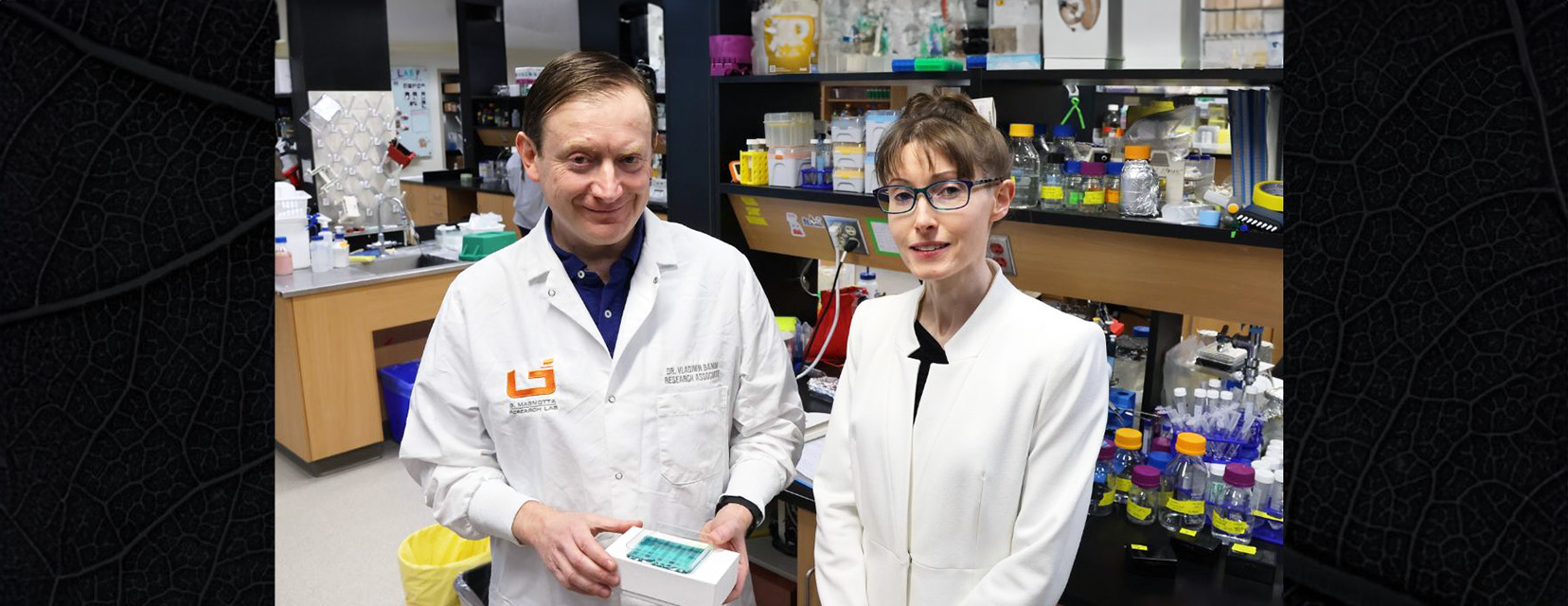
Biosensor promises a future where Lyme disease testing could take place at home
Through an international collaboration, U of G researchers have combined biochemistry, electrical engineering and physics to create a biosensor with potential to revolutionize the way Lyme disease is detected.
The team at the G. Magnotta Research Lab led by Dr. Melanie Wills, is one step closer to a more efficient and specific test for Lyme disease, the tick-vectored bacterial infection and One Health concern.
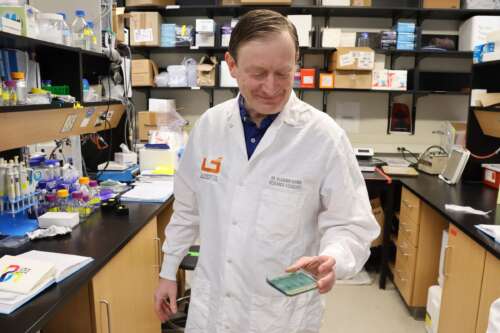
“This is a major breakthrough,” says Dr. Vladimir Bamm, a Magnotta Lab senior research associate, of the new paper published with researchers at Ben-Gurion University of the Negev in ACS Sensors.
The biosensor translates the presence of a biomarker in a blood sample into an electrical signal, Wills explains.
The sensor can detect the presence of even the smallest amounts of a Lyme disease biomarker using an integrated circuit, a microchip, that translates its finding into the signal a computer can read.
Similar to the way people with diabetes use a glucometer, the device identifies a pathogen’s presence, making testing for Lyme disease something anyone could do at home with a simple blood sample.
Still a proof of principle, the work is promising and the U of G researchers remain cautious but optimistic that the device will make detecting and diagnosing Lyme more efficient.
“Ideally, every member of the Lyme community would have access to this, or every family physician would have one in their office,” Bamm says.
Biosensor more efficient, effective in detecting Lyme
The pathogen that causes Lyme disease is notoriously difficult to detect, and conventional testing methods are inadequate.
“The biosensor is a much more effective and much more specific way of detecting pieces of the pathogen,” Wills says. “No tests in Canada actually look for the pathogen; they look for the immune response.”
The two-tier testing approach that is currently used in Canada is not sensitive enough in the early period of infection, when a definitive diagnosis would enable prompt treatment and prevent the pathogen from spreading in the body. The test also isn’t helpful for monitoring treatment outcomes. In addition, it can be inefficient and labour intensive to perform.
In Canada, the number of people who contract Lyme disease rises approximately 20% each year. Most cases are reported in Nova Scotia, Ontario and Quebec. However, the actual number of infections is believed to be higher than data reflects, and a warming planet means climate change is increasing tick populations and expanding their geographic locations.
International collab bridges engineering, biochemistry, physics
The team at the Magnotta lab has pursued a range of processes to solve the problem of Lyme disease diagnosis. Some are more practical, following prior conventions and requiring blood samples to be separated, while some are more innovative.
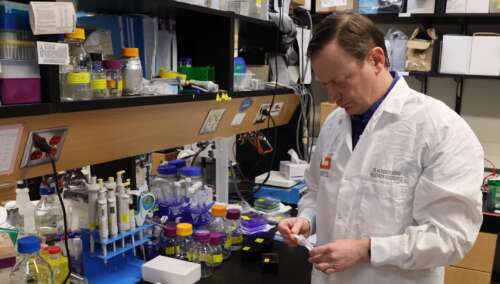
“For us, it is important to use all components of blood,” Bamm says, eliminating the risk of disposing blood that could have the identifiable pathogen.
Currently, the biosensor is a lab prototype. To come to market, it would have to undergo clinical testing and then be miniaturized, mass produced and productized to be viable. “We have the engine,” Wills says. “Now we need to build the car.”
In collaborating with Dr. Gil Shalev, head of the Lab for Emerging Device Technologies at Ben-Gurion University of the Negev, the team learned that because of engineering principles, the idea is feasible.
“This was a very effective collaborative effort in multiple fields of science,” Bamm points out. “Here we’ve merged electrical engineering, biochemistry, biophysics, physics, material science, microbiology and medical sciences including hematology.”
The G. Magnotta Research Lab is supported by the G. Magnotta Foundation, Canada’s only non-profit organization focused on learning more about Lyme disease through scientific investigation.