Master of Medical Foundations answers demand for Canadian health care professionals
A new graduate program at the University of Guelph is preparing students for a future in health care and medicine.
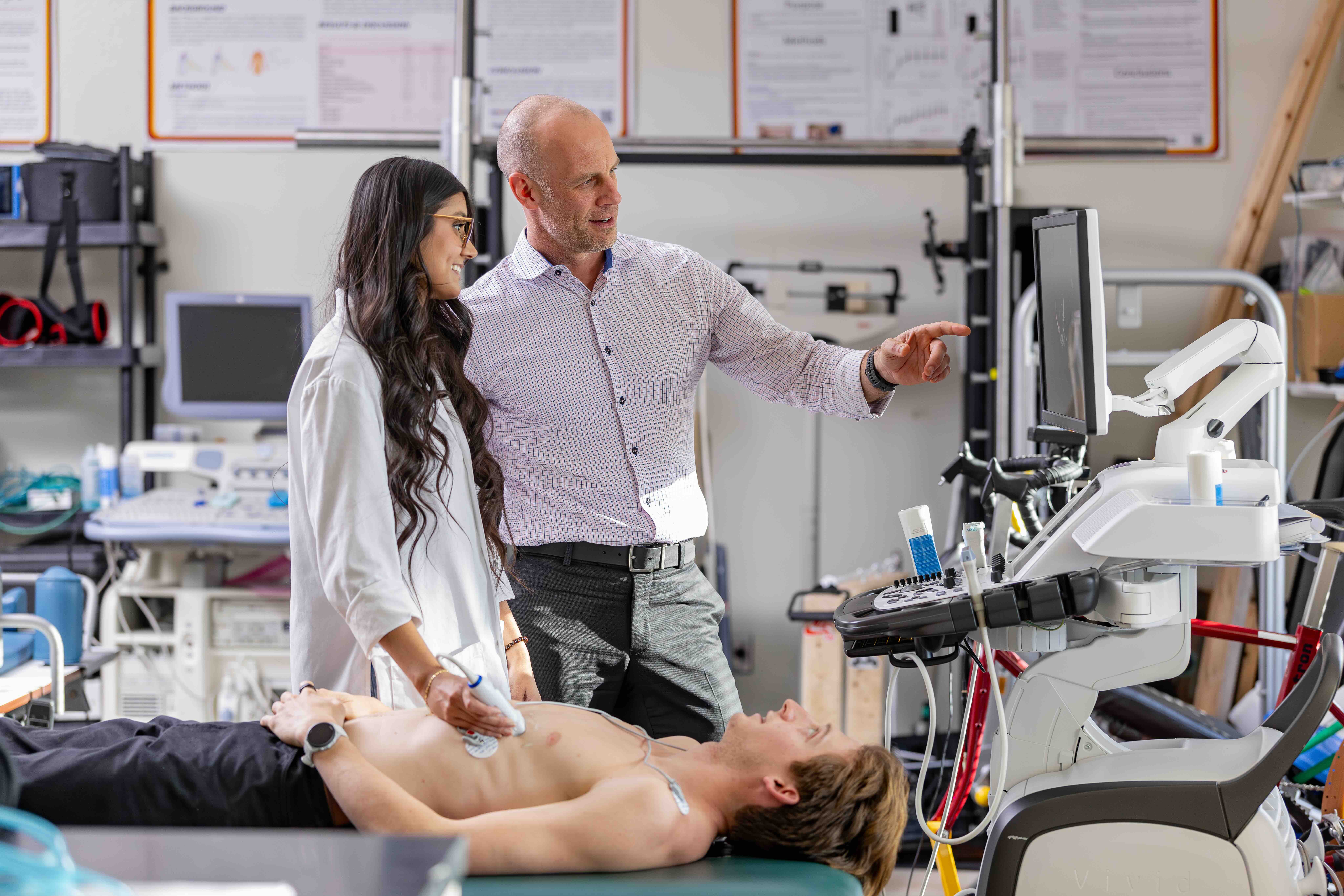
Over three semesters, students in the master’s program will explore various topics in disease treatment, physiology, health and wellbeing while using award-winning facilities across campus. This includes the highly regarded Human Anatomy Laboratory at the College of Biological Science.
Amid reduced anatomy training hours in medical schools across Canada, students will gain competitive skills through in-depth study of anatomical structures, dissections and small-group learning in a lab that hosts one of the best human anatomy programs in Canada.
Master of Medical Foundations closes critical health training gaps
The Master of Medical Foundations (MMF) is uniquely inspired by the first-year medical school curriculum. It was developed in consultation with doctors and educators who identified major knowledge gaps in their students.

Dr. Danielle Bentley, MMF program director, anatomist and education researcher, says that a consistent insight among health professions educators was that many students in health training struggle to connect their foundational science education to applied clinical scenarios.
“For example, they may know basic anatomy and be able to identify basic structures,” she says, “but have difficulty conceptualizing how those structures actually change with injury or various disease progressions.”
To that end, the MMF curriculum uniquely emphasizes clinical application and relevance.
While many pre-medical students may be interested in the program, students will develop an integrated understanding of the human body that will serve them well in any health care profession they pursue: physiotherapy, occupational therapy, nursing, radiation sciences and other allied health fields.
We sit down with Dr. Bentley to learn more.
Foundational medical knowledge meets hands-on learning: Q&A
What will students walk away with when they graduate?
A strong foundation in human health that supports a wide range of health care and health-related careers. The MMF program was intentionally designed to be clinically relevant. Students aren’t just learning facts about anatomy, physiology or disease in isolation – but how these concepts relate to real clinical contexts and thoughtful scenarios that progress through the entire spectrum of patient care.
Imagine symptom presentation, leading into diagnostic testing or diagnostic imaging, leading into best-practice interventions. Students learn about interprofessional health care teams and who contributes at each stage within patient-centred care.
As the MMF program director, I am particularly excited about creating a supportive learning environment that’s also academically rigorous and grounded in evidence-based teaching practices, to help students reach new confidence and competencies as they prepare for the next step in their careers.
How might this program improve students’ chances of getting into medical school?
While many of our students will be interested in medical school, the MMF program will support success across the full spectrum of health care professions. That said, our MMF students will have access to optional workshops that offer support with MCAT preparation, application strategies and interview skills.
Academically, all students receive advanced, clinically integrated training in core subjects across health care education.
Professionally, students will have access to community-based placements across various health care settings, facilitating their growth as leaders.
Perhaps most important, though, is the confidence our students will gain through hands-on learning and applied problem-solving. They’ll be better prepared to articulate their readiness for demanding health care programs, whether that be in medicine or allied health professions.
The Human Anatomy Laboratory is a cornerstone of this program. What can students expect?
The University of Guelph has one of the best human anatomy programs in the country.
Within the Clinical Human Anatomy course, students will learn in the Human Anatomy Laboratory with human body donors. They will participate in dissection-based laboratory activities and procedure-based laboratory experiences in a truly unique way.
As both an anatomy instructor and an education researcher – using my expertise to inform classroom teaching and student assessments – I’ve intentionally designed the Clinical Human Anatomy course with both proven content delivery methods and innovative assessment strategies. These include active and engaged in-class learning and interprofessional group work, to name a few.
By scheduling this advanced anatomy course alongside their Multisystem Human Physiology course, we have been able to weave concepts throughout, with weekly integrated cases involving chronic disease, trauma, surgery, aging and injury.
Why is this program important in Canada right now?
Health care professional programs and medical schools are facing increasing curricular pressures. As new competencies such as communication and professionalism are added alongside new bench science topics, basic anatomy training hours have been significantly reduced. In fact, many health care training programs have opted to remove in-lab dissection entirely from their curricula.
The Master of Medical Foundations program helps address this gap by offering dedicated, dissection-based anatomy training before students enter their professional programs. By engaging with human donors and learning anatomy through a clinical lens, students develop a depth of understanding that may be difficult to achieve once they reach professional school.
Beyond their professional training, working alongside human donors will help our students develop a strong sense of empathy.
While this program builds scientific and technical skills, it also provides a deep understanding of the social, economic, cultural and behavioural factors impacting human health. Lifestyle medicine and the social determinants of health are integrated throughout the MMF program. Graduates will be equipped to take on a holistic, compassionate, and human-centred approach into their future careers.
Patient-centred care always starts with seeing the person. And that is an insight we want all students to take away.
Apply now to the Master of Medical Foundations
Applications for the MMF program are open. For more information, visit the official program website.