
U of G case study to learn how to create inclusive, accessible public spaces that create community all on their own
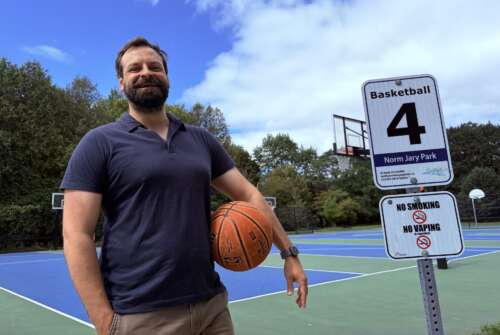
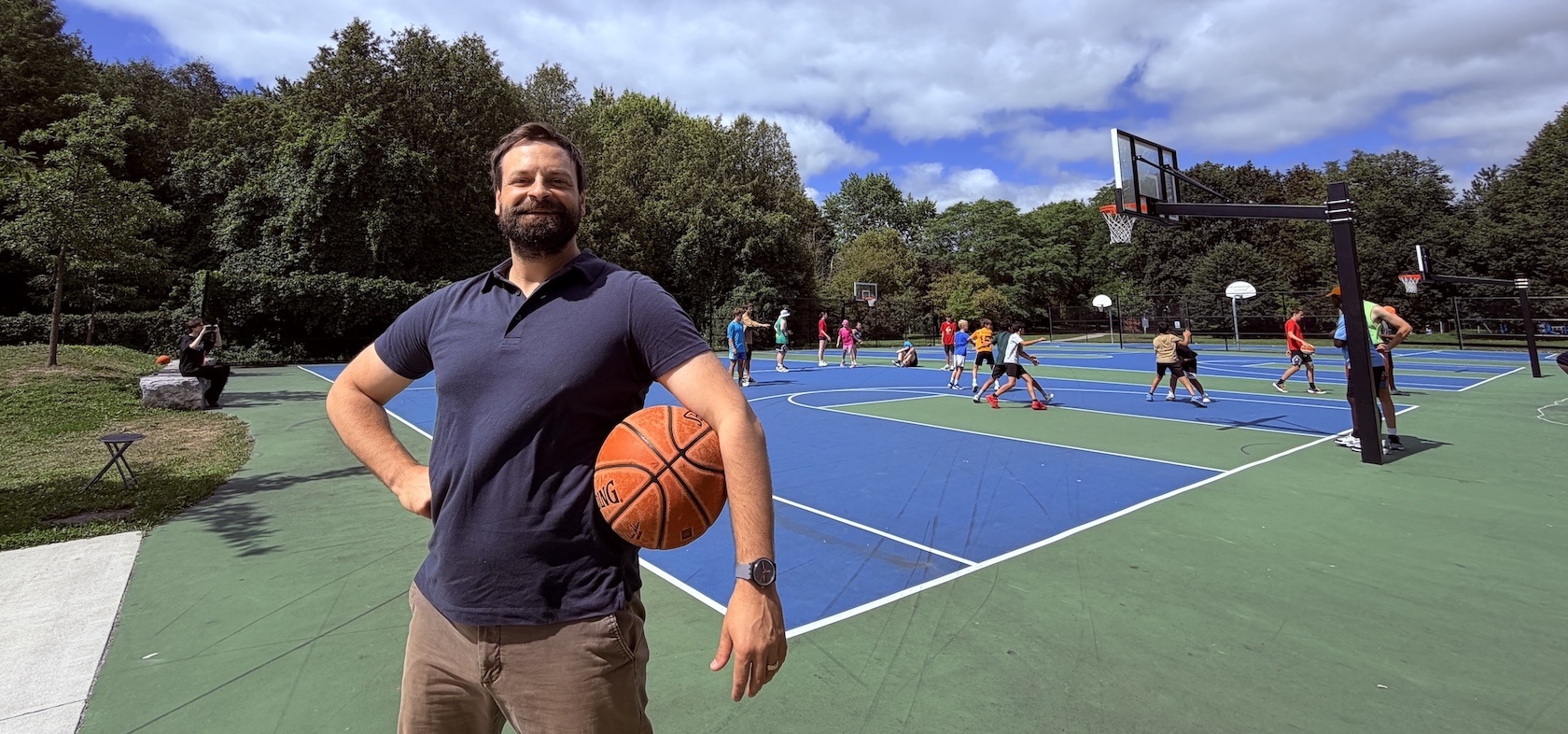
Tucked away in the open space nestled between a community centre and a border of woodland, something special is happening at Norm Jary Park that could inform the way the City of Guelph designs public space.
Newly refurbished basketball courts are bringing together players from diverse backgrounds who speak a variety of languages and span multiple generations. In addition to the pick-up games and summer camps taking place on the courts, the wider park that surrounds them has become a community hub, transforming what the City classifies as a priority neighbourhood.
It is the impact of this social exercise that Dr. Jordan Zalis, a postdoctoral fellow with the International Institute for Critical Studies in Improvisation (IICSI) at U of G, is studying in partnership with the City.
“To inform upcoming capital planning and programming decisions, the municipality needs evidence demonstrating how and why this space succeeds,” Zalis says.
Part of what makes the basketball courts a unique case study is their improvisational nature. Unscheduled, free use of public space is common in other parts of the world, Zalis points out. “How do we find, cultivate and make available these spaces for people here in Guelph?”
The power of community-engaged research
Zalis’ research explores how pickup basketball models improvisatory behaviours that transcend social and cultural differences, increasing sociality among diverse communities.
An ethnographer (ethnomusicologist) by training, Zalis takes an immersive approach. “I hang out in the places where I do research,” he explains. “I observe, I talk to people, I ask questions, I record the sounds around me.”
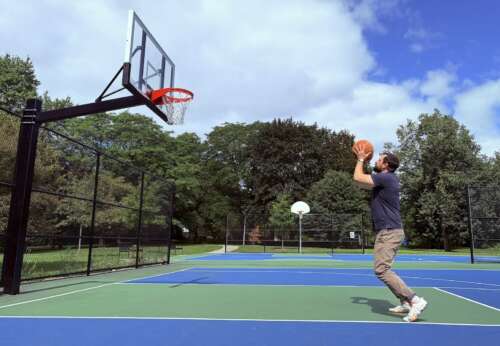
Listening centres his practice: “What does basketball sound like?” he asks. “What do we hear when we navigate public space?” “What can our senses tell us that mere headcounts cannot?” “What can we learn by listening?”
Housed in the College of Arts, IICSI creates positive social change through scholarship, arts events and other community-oriented activities. Working with researchers, students, creatives and community partners, its goal is to practice and study improvisation as a model for social change.
“Community-engaged research allows us to understand how the residents of a community actually use public spaces and what makes them feel welcome, or excluded, within them,” Zalis says. Cities across Canada are struggling to address increasing social isolation and to create inclusive, inviting public spaces where community members can practice the skills of living together, he adds.
To have a researcher dedicated to one specific community is invaluable to the City, which responds to the needs of its 140,000 residents in a wide variety of neighbourhoods, says Adam Rutherford, manager of programming and community development with the City of Guelph.
“This research could have a profound impact on how municipal governments think about infrastructure spending,” Rutherford says. Partnerships like this help the City build their case for grant funding and other support.
Community hubs contribute to community health, Rutherford says, and improve outcomes for youth in the City.
“We want people to come and spend time in our spaces,” he says. “Free public spaces are invaluable in getting people engaged and active, without breaking the bank.”
Making public space truly accessible
Now in its second phase, the project has yielded some preliminary learnings, namely that less programming in a public space is a good thing. Research shows that a lot of programs have components that are not inclusive, Zalis says. For example, some public spaces require you to sign up using digital tools, assuming everyone has access to them and indirectly creating exclusions.
“Perhaps it is time to rethink public space and how it is utilized. This basketball court is a shining example of what it looks like when it works.”
Through interviews, Zalis has spoken with many residents of the neighbourhood, some who have lived there for decades, and tell him it feels much safer now, more connected and livelier.
“People have wildly different expectations of public space, depending on how and where they grew up,” he points out. The neighbourhoods surrounding Norm Jary are home to many newcomers to Canada, some of whom live in apartment building without private outdoor spaces.
“This project is about finding creative ways to tackle social programs, listening to people who don’t look or sound like you, or have the same life experiences.”
This research is supported by a Partnership Engage Grant from the Social Sciences and Humanities Research Council (SSHRC).