
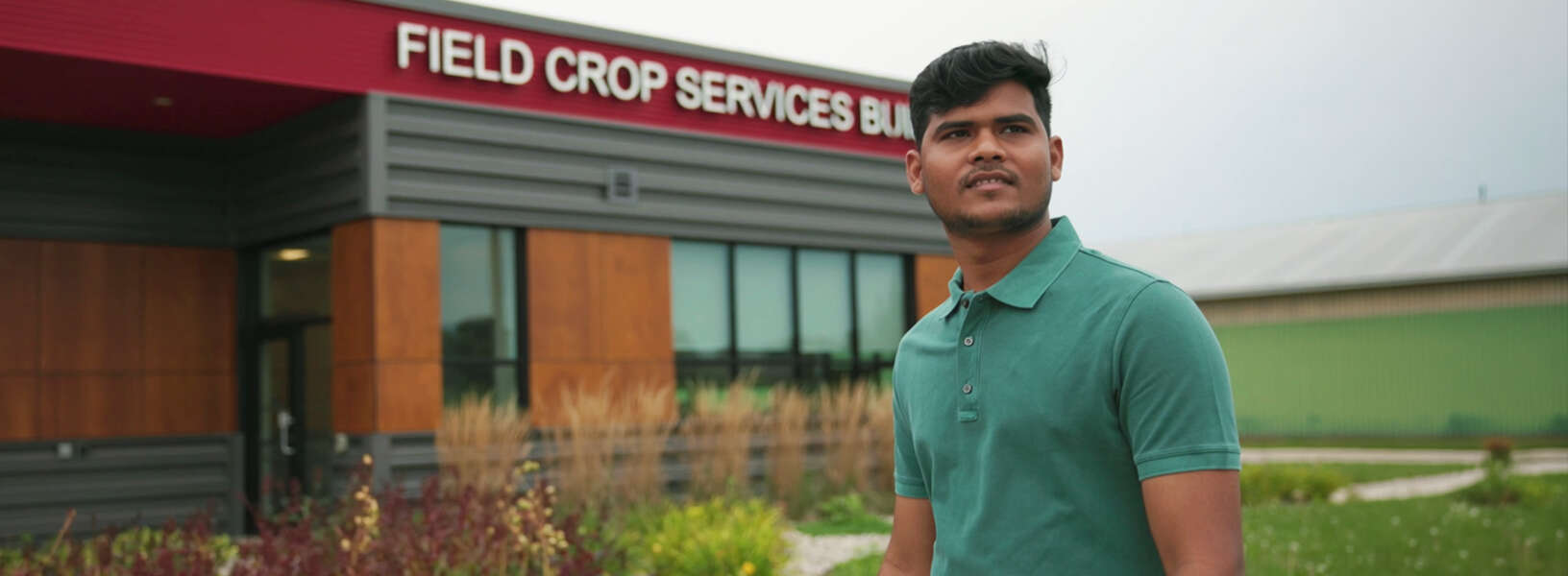
Research from Ontario Agricultural College master’s student Vijay Velusamy helping ensure soils remain safe and productive
Raised in a farming family in Tamil Nadu, India, MSc Environmental Sciences student Vijay Velusamy saw first-hand how soil conditions, weather and sustainable farming practices shape the lives of producers. Velusamy is now applying his experience in agriculture to research at the University of Guelph that could help reduce plastic pollution and protect valuable farming land in Ontario.
“Plastic packaging is everywhere, and much of it ends up in agricultural fields,” says Velusamy. “If a farmer is going to use plastic containers or mulch sheets, it’s important to explore alternatives that can reduce cost and also improve soil health and yield.”
As part of a research program at U of G’s Ridgetown Campus under Dr. Brandon Gilroyed, Velusamy is comparing how biodegradable plastics degrade in controlled laboratory experiments as well as in agricultural field experiments.
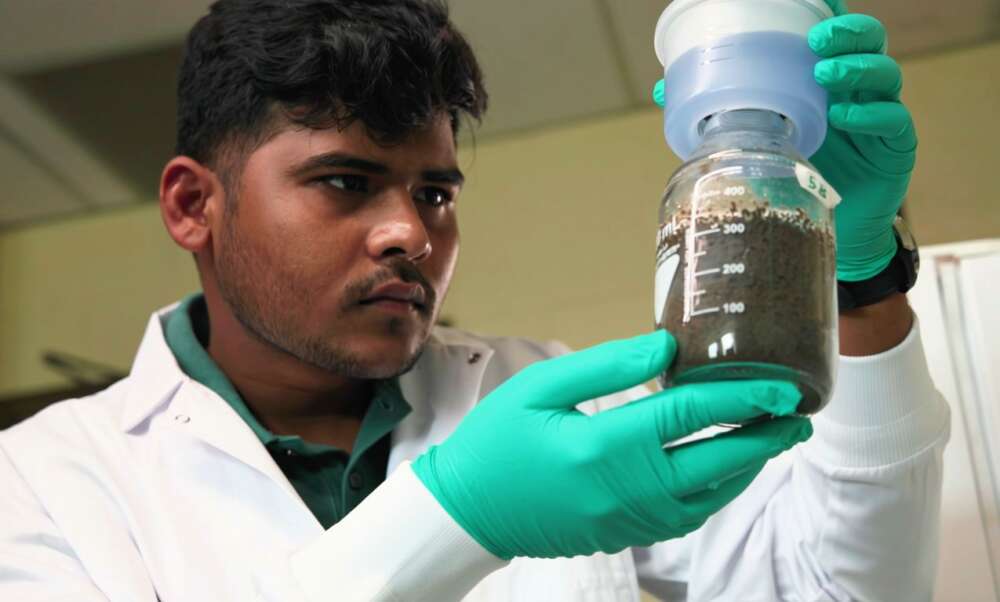
“When plastic waste stays in agricultural soil, it can affect soil health, water movement and plant growth,” says Velusamy. “It’s important to examine how biodegradable plastics break down in the soil so we can build a case for widespread use,” says Velusamy.
Velusamy measures the change in biodegradable materials over time, including how much mass they lose, how much carbon dioxide they release and how much oxygen is consumed as they decompose.
This research is funded in part by the Ontario Agri-Food Innovation Alliance, a collaboration between the Government of Ontario and U of G that drives innovation to power economic resilience in Ontario’s agri-food sector.
Research like this helps ensure safe and reliable soils for Ontario growers to protect the province’s food system.
Research rooted in real-world agriculture
U of G’s Ridgetown Campus has been an important part of this work. With laboratory facilities and the Ontario Crops Research Centre – Ridgetown agricultural field sites close together, Velusamy can conduct experiments in both settings and compare the results directly.
“Our findings could help inform the development and evaluation of more sustainable packaging that reduces plastic waste while protecting the soil that supports food production,” says Velusamy.
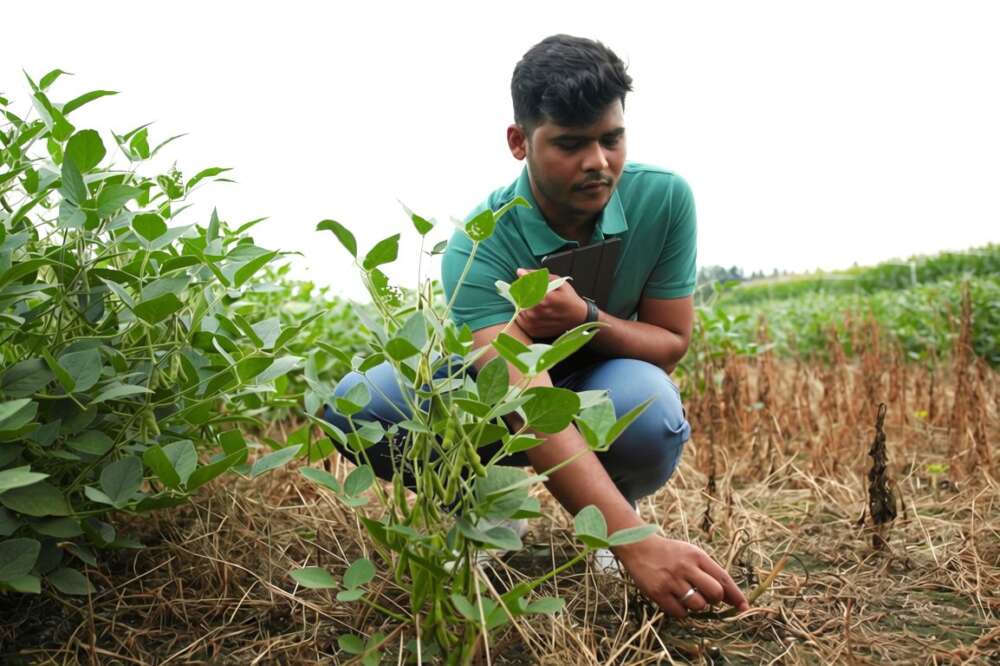
For Velusamy, a healthy food system can be tied directly back to healthy soils.
“Food is grown in soil and its waste often returns to the soil as compost,” says Velusamy. “If biodegradable packaging breaks down properly, it could help keep plastics out of that cycle and protect the land farmers depend on.”
Velusamy’s work has already earned recognition. In 2026, he received awards at several poster competitions, including at the joint meeting of the Canadian Society of Soil Science and Canadian Society of Agronomy.
Finding a home in Canada and U of G
Velusamy arrived in Canada with high expectations and plenty of motivation, but admits that adjusting to a new culture, climate and food took time.
He credits the U of G community with helping him settle in, pointing to the support available through his research team, campus services and graduate student resources. Dr. Gilroyed and his fellow lab mates have been an important source of guidance.
“The University of Guelph gives me a good opportunity to learn more about the people and how the Canadian culture works,” Velusamy says. “These are the things that make me comfortable and also help me to feel like Canada is a home for me.”
This research has received funding from the Ontario Research Fund, and U of G’s Centre for Agricultural Renewable Energy and Sustainability (CARES) and Bioproducts Discovery and Development Centre (BDDC). The Ontario Crops Research Centre – Ridgetown is owned by Agricultural Research and Innovation Ontario, an agency of the Government of Ontario, and managed by U of G through the Alliance.