
Independent study courses offer professionalized opportunities in an array of cultural fields
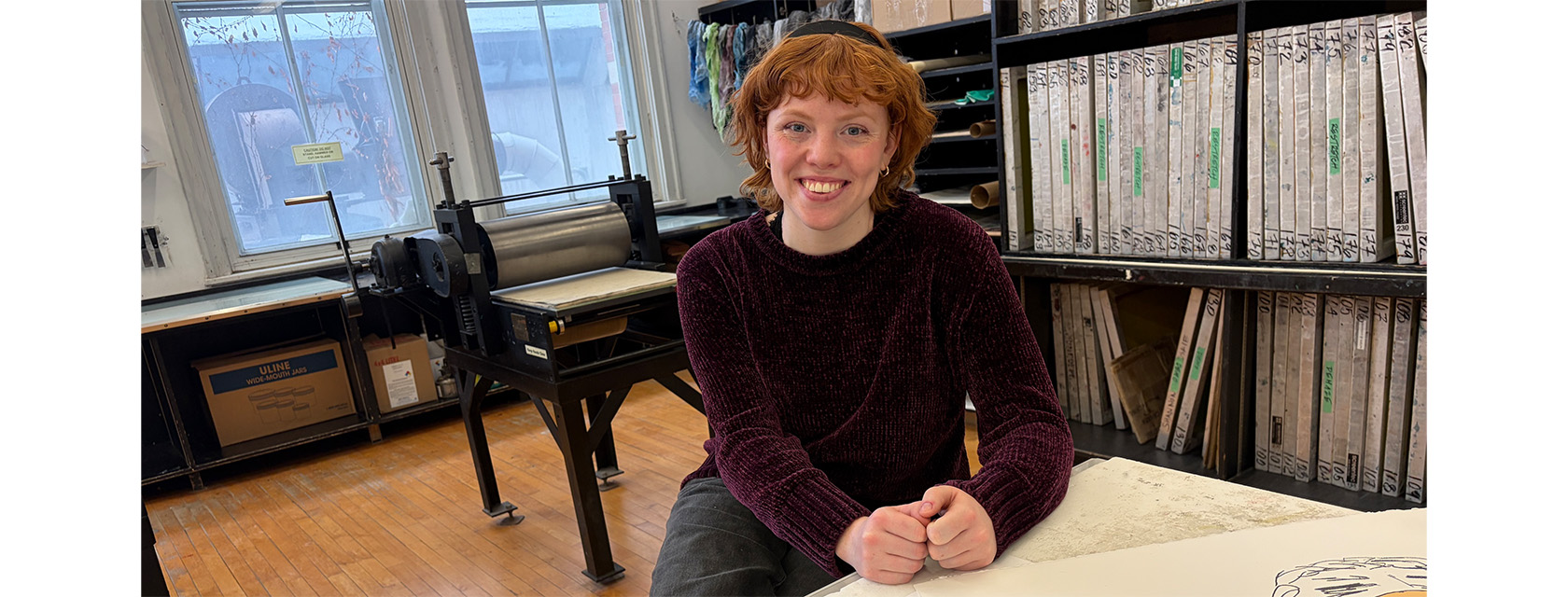
Avery Riley-McKay arrived at the University of Guelph to pursue her passion as a painter, communicating messages through visuals.
In the School of Fine Art and Music (SOFAM), the fifth-year Studio Art major fell in love with the program and the way it expanded her knowledge beyond technical practices.

“It taught me how to look at the world and how to understand how it is perceived, and the role art plays in that,” she explains. “I think the skills that you learn are applicable to every different career path in some kind of way.”
Eager to expand on those skills, Riley-McKay signed up for SART Experiential Learning, a two-part independent study course that offers an educational internship and a course credit.
The opportunity, open to third and fourth-year Studio Art students in any semester, provides the experience of working in an off-campus environment in the cultural field. Students often work one day per week in a local art gallery or a museum or in the studios of professional artists like Azadeh Elmizadeh. Some have worked with community-based organizations like the Guelph Arts Council or with art therapists.
“It is the best complement to in-studio study,” says Martin Pearce, professor of Studio Art, who advises students like Riley-McKay through the SART course.
“It is our responsibility to think about what a student will do the day after they leave U of G, not on their first day at the university,” he says. “I think that distinguishes our art program.”
ISB Global houses rotating U of G student art collection
Pearce encouraged Riley-McKay to work with ISB Global Services, a new SART partner looking for some artwork to display throughout their Guelph headquarters. The inquiry provided a new kind of opportunity for Riley-McKay – to take on a curator role.
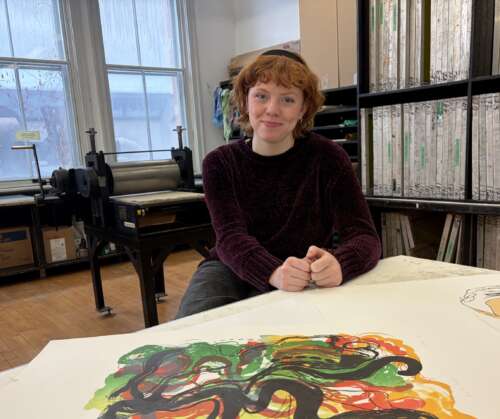
“To say she stepped up, is an understatement,” Pearce says. “Avery has pursued this in such an extraordinary way.”
Working with Allen Ash, a printmaking technician at U of G, Riley-McKay sourced prints from the student archive, learning to sort and date them in the process. “I felt like I could do that because I had such great support,” she explains.
She then devised a series of questions for ISB’s staff, inquiring about their personalities and the colours they liked, to match the art with the person in whose office it would hang. “It was very much a collaborative process,” she says. “I was very happy to do it that way, so that everyone received art they wanted and felt like they had a hand in it.”
Thirteen ISB Global offices are now home to 22 pieces of U of G student art with new matting and frames that will rotate each semester.
“Through this initiative, ISB wanted to provide University of Guelph students with a platform to share their work, while also offering experiences that connect academic learning with real-world business application, supporting them as they prepare for their post-university careers,” says Stephen Anderson, chief operating officer, ISB Global Services.
“Community support and meaningful connections are values that ISB strongly believes in. We strive to be good neighbours, just as U of G has been to ISB. The students, staff and faculty who contribute so much to the city of Guelph reflect the welcoming, collaborative culture of the university that we are proud to be a part of.”
Experiential learning builds lifelong networks
The goal of the SART courses is to offer students professionalized opportunities, similar to the world they will encounter upon graduation. “The Studio Art program at U of G is highly respected in the sector, precisely because of its balance between training outstanding artists in the classroom and preparing them for success outside of the classroom,” says Dr. Kimberly Francis, director, SOFAM.
“The Studio Art faculty’s commitment to the undergraduate experience is second to none,” she adds. “When you join this program, you join an extensive network of artists who play a significant role in defining the creative industries in Ontario and beyond. Avery’s outstanding work is just one example of the unique training our students receive here in SOFAM.”
Host partners are often connections that students keep throughout their careers, and provide valuable, real-world advice. Some students have also been asked to stay on and offered permanent employment.
Experiential learning opportunities are a key part of the pitch Pearce gives to high school students every year for recruitment events.
“Some of the opportunities working with high profile artists have been transformational for our students,” he says, adding the experience can be beneficial whether a student is planning to attend graduate school or simply informing their own studio practices.
“We would like all of our students to take these courses,” he says. “They come out of U of G on a springboard.”