

“Fiction can change our lives.”
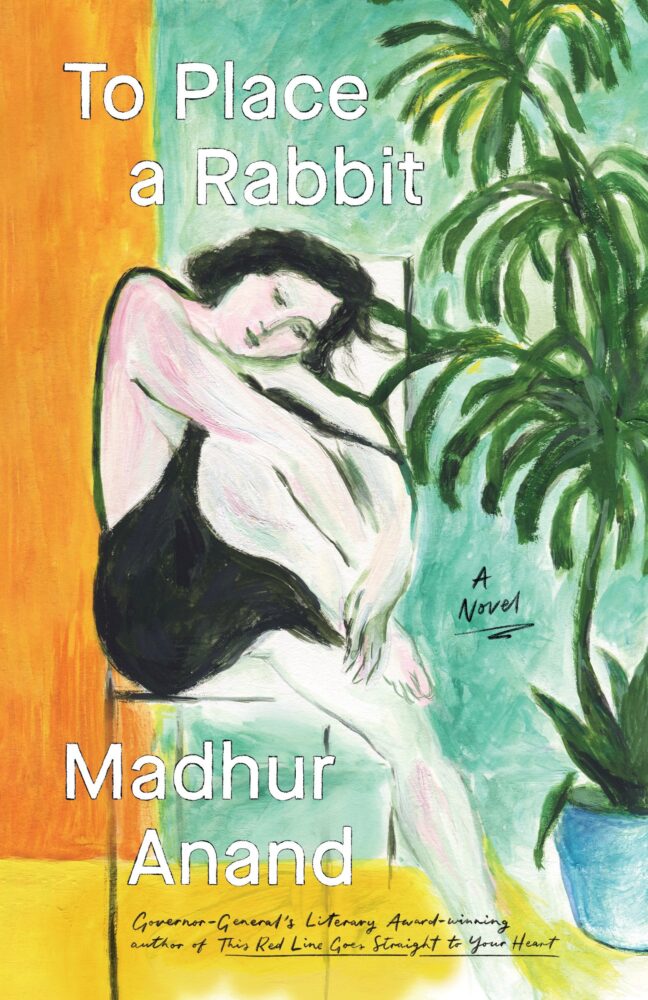
In her debut novel To Place a Rabbit, Dr. Madhur Anand, award-winning poet and environmental sciences professor at the University of Guelph, wants us to reflect on the power of books, language, translation and most of all, love.
“Our most pressing crises do not necessarily need new solutions – we already have many good ones we simply need to apply – but better translators between the disciplines,” she says. “We must communicate better with each other, whether between science and society, between art and science, between groups or nations – or between two human beings.”
At U of G, Anand answers that call, integrating both science and the arts as an ecologist, writer and leader of The Collaboratory, an interdisciplinary group that joins creative writing, environmental science and the arts.
Teaching courses like Creative Writing for Environmental Scientists, she shows students the role that creative writing and art can play in reinvigorating scientific thinking and communication.
That work is brought to new life in her novel, featured in The Globe and Mail as a must-read of 2025.
To Place a Rabbit tells the story of a scientist who begins a friendship with a novelist after offering to translate her French novella into English. But the scientist’s own memories of a passionate love affair begin to haunt the translation. Soon, all is complicated, and the protagonist realizes the life of writing is taking over her real life.
Anand, author of four critically acclaimed books, including a memoir that earned her the Governor General’s Literary Award for Non-fiction, joins U of G News to discuss her writing process, unusual structures and her first foray into fiction.
Why did you decide to write To Place a Rabbit? What were your inspirations?
I did not decide to write To Place a Rabbit. I was compelled to write it.
I was working on a completely different novel at the time about natural history museums, having abandoned an idea for a non-fiction book about reconciling paths not taken.
Then, something happened. I attended a literary festival, and I found the key to unlock my desire to write fictionally about the past. The novel then sought inspiration in the power of translation to revisit the past and even imagine the future. And it was inspired by the unconventional nature of love. Natural history museums (though they do find a part in the novel) would have to wait.
Once I discovered its three-part structure, and I realized that through translation, it became possible, if not inevitable, to create fiction, To Place a Rabbit flowed out of me in a matter of weeks.
Your work often does not follow a conventional structure. Why is that?
My work as a scientist makes many structures available to me that have not yet been used in literary works, because not many scientists are writing poetry or novels.
Nature has so many interesting structures, and I have found many while studying ecosystems (e.g., non-linear dynamics, tipping points, strange attractors, turbulence, stochastic resonance). Some of these are still quite theoretical and have not yet seen widespread applications. But I think some of these structures are general enough to be found in our human stories.
The repetition of sections in To Place a Rabbit, and then the mixing of them at the end in the section called “Menage à Trois,” resembles a model that I developed over 25 years ago as a PhD student, in which a system undergoes recovery as it moves from predictable states to a noisy one. It could also resemble a population model that shifts from cyclical behaviour to chaotic dynamics.
I think novel structures in storytelling help us imagine the world in new ways and can even be truer to our experience than the stories reflected by normative narratives. Our image as humans, as individuals and as a collective, is far richer than those norms.
What is your writing process like?
When creating literary art, the structure or form is more important than content. I can’t begin writing until I have worked out the structure.
Being a scientist, I like to have lots of data points before I describe a process. To Place a Rabbit is my fourth book, but my first novel, so I don’t feel like I can generalize about my process. I think each of my literary works has its own process because each so far has a fundamentally different structure.
The work involved with each genre (e.g., whether a collection of poems or a novel), however, is the same, and it involves following obsessions towards discovery and, ultimately, transformation.
In the case of To Place a Rabbit, in practical terms, I had just come back from a trip to France and ended up using jet lag – the early hours of the morning when I was awake before everyone else in my house – to write. I was literally writing the novel through a process of catching up to the present moment, to the present time zone. Time and memory (and France) are themes in the book, so it was a perfect match.
What do you want your readers to take away?
A feeling: The pleasure of discovery.
A reflection: Fiction can change our lives.
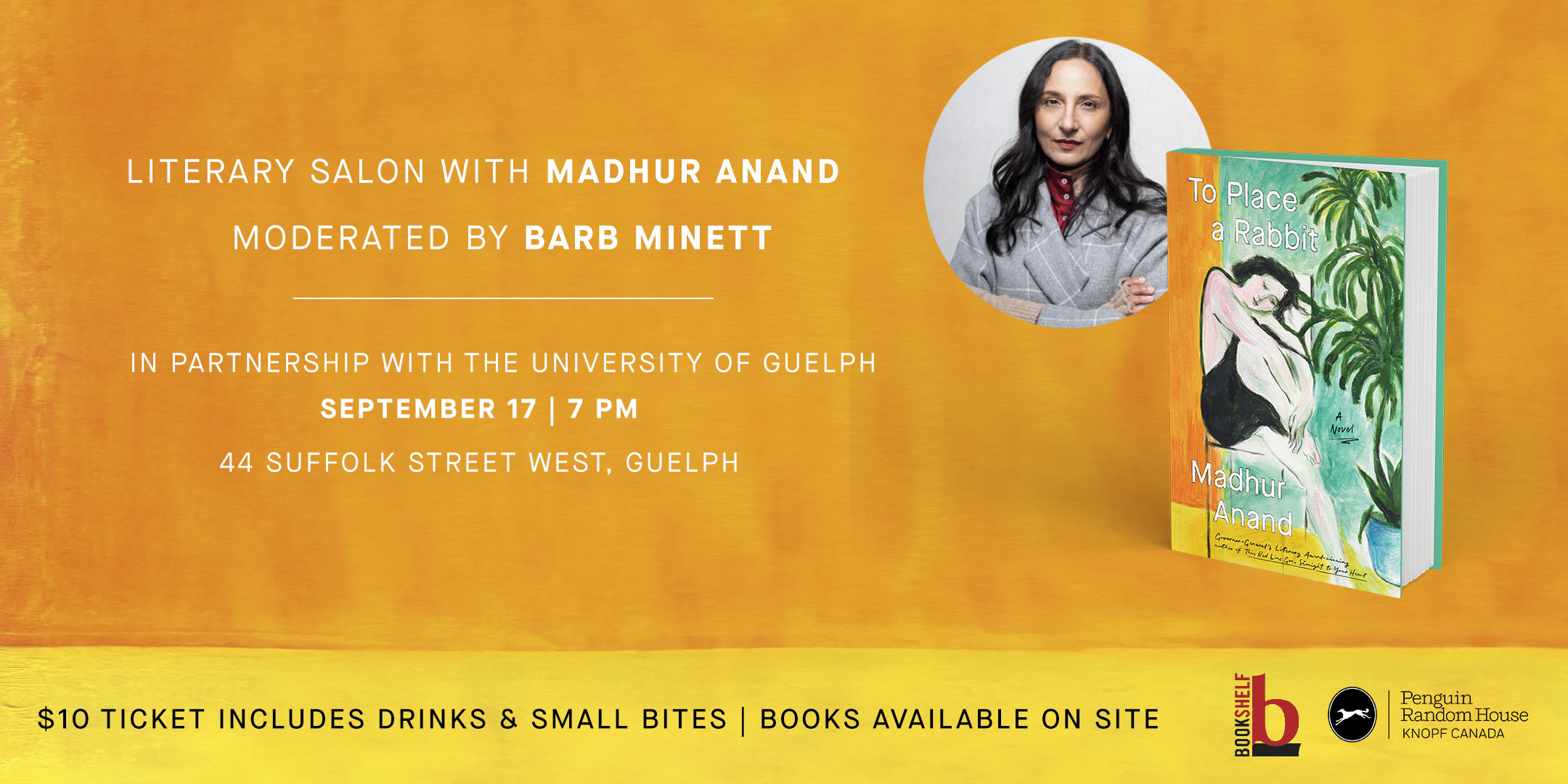
Book Launch
Anand’s book launch will take place in the fall.
Date:
Sept. 17, 2025, 7 p.m.
Location:
44 Suffolk Street West, Guelph, ON
Tickets:
Panel Discussion
Anand will be hosting a panel discussion at the Eden Mills Writers’ Festival.