
Mineral does double duty to improve soil health and capture carbon
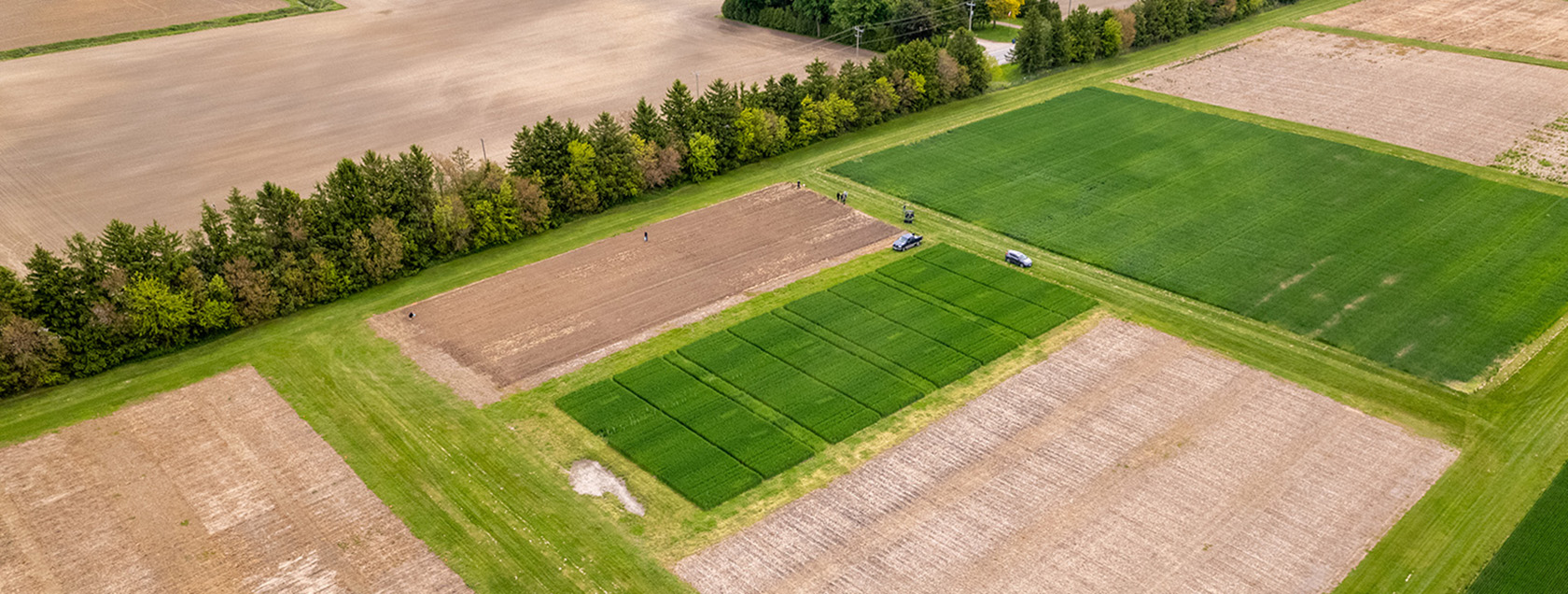
University of Guelph researchers are measuring up the opportunities for a locally mined mineral called wollastonite to capture and store atmospheric carbon while boosting soil health and crop production.
With support from the Ontario Agri-Food Innovation Alliance, Dr. Rafael Santos, a chemical engineer and researcher in the College of Engineering, has been studying wollastonite’s ability to improve soil and tackle greenhouse gas emissions. He’s digging into questions about how much to apply, which crops benefit the most and how much carbon the calcium-silicate mineral can sequester.
Santos is working with colleague Dr. Emily Chiang, master’s students Ayda Amidi and Andrea Chacon, PhD graduate Dr. Francisco Araujo and post-doc Dr. Reza Khalidy.
“Wollastonite is an interesting mineral,” says Santos. “Its needle-shaped particles are aerodynamic, stay in place and spread well when applied to soil.”
The mineral is being used by farmers instead of traditional limestone that adjusts soil pH but can dissipate in the air when applied – depending on the weather – and emit carbon.
Mined near Kingston, Ont., wollastonite is a highly reactive mineral composed of calcium and silica that’s emerging as an exciting soil amendment for reducing carbon emissions because of its unique characteristics and components.
To work, wollastonite must undergo a process called enhanced rock weathering. The mineral is crushed to increase overall surface area, expanding the opportunity for its particles to interact with soil microbes to improve soil health and store more carbon. Wollastonite “activates” in the soil with water and other plant by-products to kick in the carbon capture and soil health benefits.
Field crop testing on crop yield
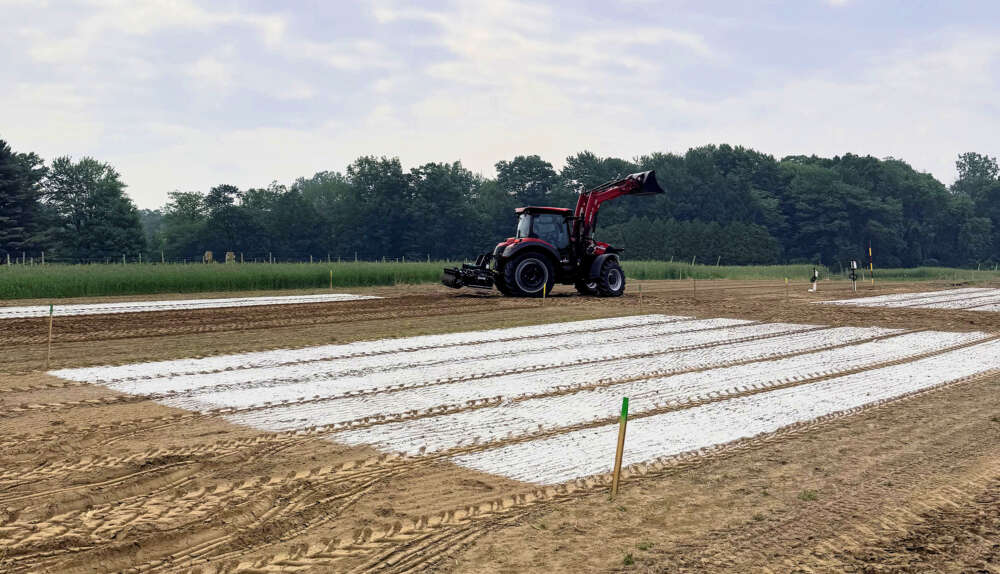
The researchers, along with manager Torin Boyle at the Ontario Crops Research Centre – Simcoe, have been studying how wollastonite impacts crop yield, plant growth, fertilizer efficiency and carbon sequestration. They are testing the limits of how much wollastonite to use and ultimately recommend to producers.
“We’ve been able to very clearly show that crops are doing much better with wollastonite,” says Santos. “There are significant effects of better plant growth and improved soil health.”
They have found that levels of carbon captured in the soil are higher in fields where wollastonite was used, and highest when the mineral was applied to soil over several consecutive years.
Most of Santos’s trials have been on soybeans that naturally acidify the soil to help the weathering process happen faster. The microbes in soybean root nodules also accelerate weathering so wollastonite can be more effective.
Field trials and testing helped Santos confirm the cumulative benefits of wollastonite. “We’ve found that wollastonite is reactive enough when you put it in the soil that you can see the effects after just one season.”
Now Santos is zeroing in on more accurately measuring the carbon capture rates in croplands where wollastonite is used. That involves determining methods for detecting weathering products and effects – for example, in the soil and in the water – that are more reliable, more economical and more feasible on a large scale. Eventually, Santos hopes farmers will have a reliable way to predict the results from enhancing soil with wollastonite.
Carbon capture options
Compared to limestone, Santos found wollastonite is able to trap twice as much carbon dioxide, reducing the chances of being released as greenhouse gas. That is great news for the environment and has attracted the interest of U.K.-based UNDO Carbon.
UNDO is in the carbon removal business and initially came to Canada to work with Canadian Wollastonite, the Kingston-based mining company. To learn more about wollastonite use in Ontario, UNDO approached Santos to provide scientific support for their Ontario endeavors, a partnership that includes instrumenting and studying the Simcoe field trial. Santos’ research also includes a collaboration with University of Washington researcher Dr. Rebecca Neumann – brought on board via UNDO – to bring hydrological expertise into the wollastonite investigation at Simcoe.
“While we have a strong focus on investigating the use of enhanced rock weathering in Ontario, our research has also impacted the U.S., U.K. and beyond,” says Santos.
In Ontario, UNDO is already working with farmers to manage the application of wollastonite on their fields, covering the purchase and application in exchange for the carbon credits generated.
“There are really interesting opportunities for Ontario farmers with wollastonite,” says Santos. “We are replacing limestone and might even be able to replace some fertilizer because of the plant health benefits – and then the climate benefits become so much bigger than just sequestration. This project is helping us find more incentives for Ontario farmers to adopt this technology.”
This research is funded by the Ontario Agri-Food Innovation Alliance, a collaboration between the University of Guelph, the Government of Ontario and its agency Agricultural Research and Innovation Ontario (ARIO). The Ontario Crops Research Centre is owned by ARIO and managed by U of G through the Alliance.