
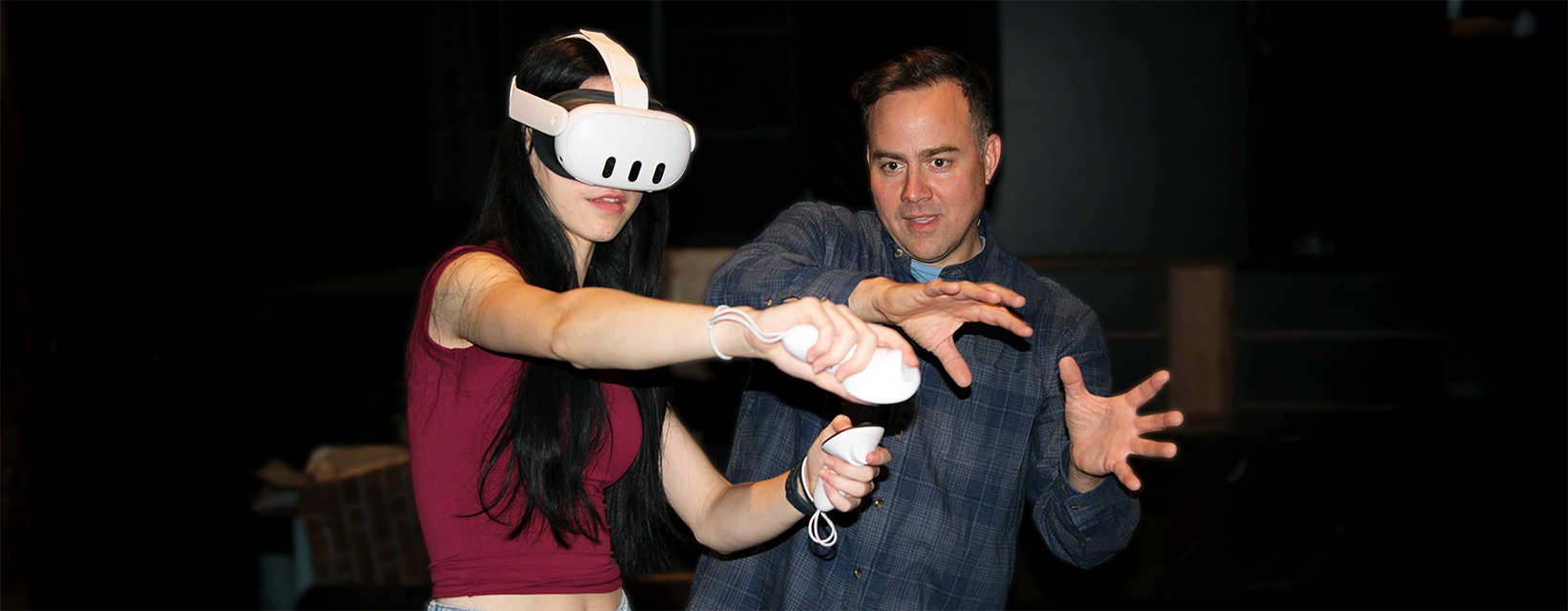
A virtual reality theatre project that helps high school students feel like they are a character in Shakespearean plays has earned the University of Guelph’s 2025 Innovation of the Year Award.
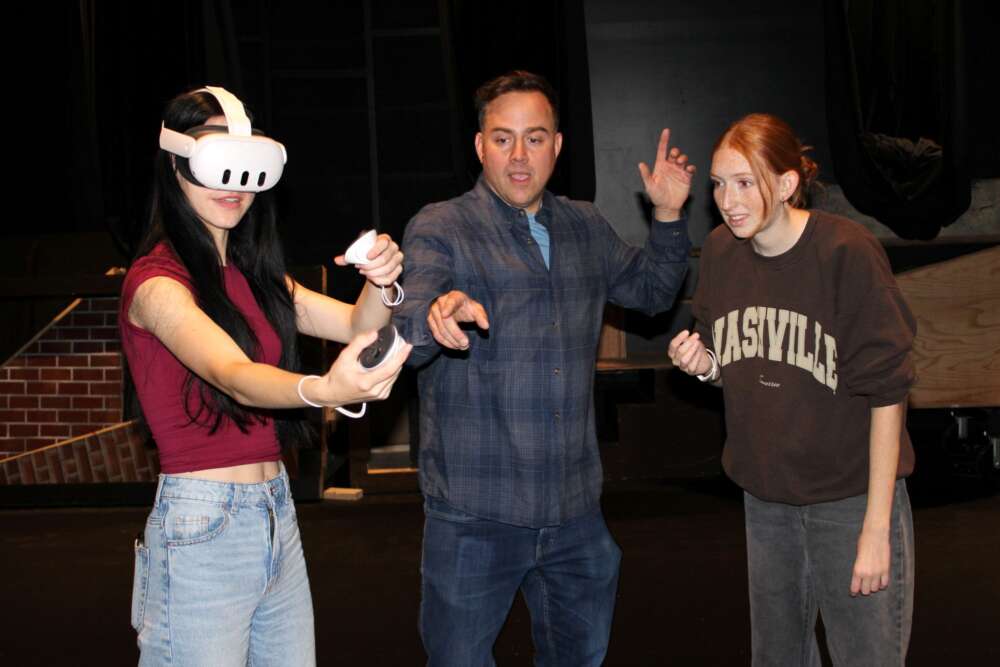
By transforming classic plays into immersive, interactive performances, the project is helping make Shakespeare accessible to all learners, no matter where they are.
The annual Innovation of the Year Award from the University’s Office of Research and the Research Innovation Office recognizes research outcomes that have led to creative strategies, companies or products that make a difference in people’s lives.
“This project is a perfect example of turning innovation into real-world impact,” says Dr. Shayan Sharif, interim vice-president, research. “By combining cutting-edge virtual reality with Shakespeare’s works, we’re improving life for students through an immersive, interactive approach that reimagines how these stories are experienced.”
Dr. Peter Kuling, professor in the School of Theatre, English, and Creative Writing in the College of Arts, co-designed the technology with Calian (formerly known as SimWave), an Ottawa-based company that specializes in virtual reality development.
“I partnered with Calian because they understood the psychological and spatial experience of being ‘inside’ a scene and gave the experience of what it feels like to explore, make choices and be immersed in an environment,” he says. “They have done work for the Canadian War Museum, which gave them a strong understanding of environmental design and realism in virtual spaces.
“They also knew how to design an environment that could shape learning, which aligned with my goal to let students experience Shakespeare’s plays rather than just watch.”
Invention in use as a digital teaching resource

The project began during the COVID-19 pandemic, when the Government of Ontario launched a funding call for digital and innovative teaching projects that could be used in high schools, colleges and universities.
Kuling saw an opportunity to explore how to bring the theatre stage to students.
“I kept wondering what theatre could offer in a digital world and what I would have wanted in high school to truly understand Shakespeare. This project gives students a chance to experience Shakespeare not as a distant text, but as a living, breathing world they can step inside.”
Kuling and his team began with the Hamlet VR Experience, followed by the Macbeth VR Experience, transforming the plays into interactive productions lasting 12 and 26 minutes.
In Hamlet VR, players become the character Bernardo, a castle guard who encounters the ghost of Hamlet’s father. They can choose whether to speak his lines or let an actor do so. In Macbeth VR, players become one of the three witches, casting spells and delivering Macbeth’s prophecies in key scenes. They can also replay the experience from each witch’s unique point of view, seeing the scene differently each time.
The experiences are intentionally inclusive, featuring diverse characters and environments that reflect contemporary Canada. They are accessible to a wide range of users, offering options for standing or seated play as well as multilingual support through recorded dialogue rather than on-screen text.
The result has been a powerful new way for Ontario high school students to engage with Shakespeare. It is freely available to Ontario schools and used by educators from California to the United Kingdom.
Recreation of Globe Theatre coming next
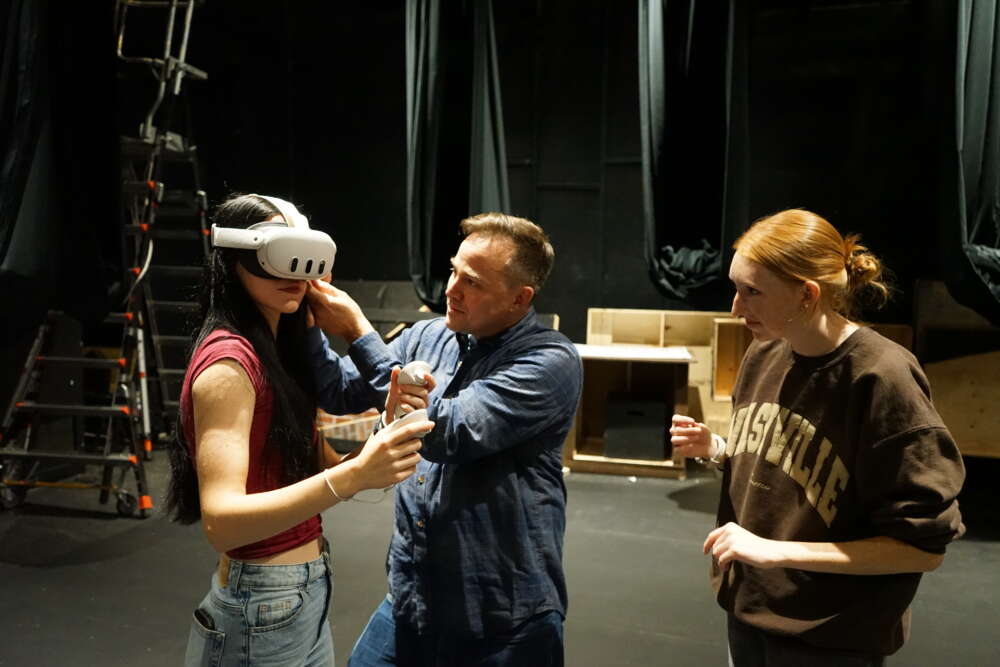
Educators across Ontario are incorporating Shakespeare VR into classrooms, using them as a digital teaching resource. At John Fraser Secondary School in Mississauga, students have engaged enthusiastically with the VR experiences.
“Watching students step inside the world of the play was incredible, and even those who are usually shy lit up,” says Robert Gale, an English and history teacher at the school. “The immersive details and 360-degree environment helped them feel the story rather than just read it, and it brought Shakespeare to life in a way I’ve never seen in a classroom.”
Kuling plans to expand with additional Shakespeare plays, including VR Julius Caesar and VR Antony and Cleopatra. He is currently developing Globe VR Experience, a virtual reality recreation of Shakespeare’s Globe Theatre that allows students to experience Shakespeare’s original theatre. It is set to launch in 2026.
“With the Globe VR Experience, we’re bringing Shakespeare’s world directly to students, with no travel required,” he says. “We can bring world-class performances directly to students at every level, from high school to university.”
Kuling sees receiving the Innovation of the Year Award as a shared achievement, not just an individual one.
“This project was built on collaboration and creativity, and the award truly belongs to everyone who worked together to make something innovative and inspiring,” he says. “It’s humbling to see an idea that grew through teamwork and imagination recognized as Innovation of the Year. This work is about expanding educational opportunities, supporting students and showing how the arts can innovate alongside technology.”
A number of collaborators helped bring the virtual performances to life, including Theatre Studies PhD students Alice Hinchliffe and Erin O’Brien, alumni Gabriella Sundar-Singh, Kyle Blair and Kyle Golemba, and company members from the Stratford and Shaw Festivals.
This research was funded by the Ontario Exchange Network.