
A crisis nearly 100 years ago provides lessons for building a more resilient food system today, says a University of Guelph global food expert in a new radio documentary.

Dr. Evan Fraser, executive director of the Arrell Food Institute and professor in the Department of Geography, Environment and Geomatics, discussed the parallels of the Dust Bowl era to today’s food system troubles in a documentary called Dust Bowl Blues, which aired this week on CBC Radio’s Ideas.
The documentary, named after a song by folk singer and Dust Bowl refugee Woody Guthrie, explores what the past can teach us as we face another precarious time. It features conversations with Dr. Pamela Riney-Kehrberg, professor of history at the University of Iowa, and Dr. Rob McLeman, professor and chair of the Department of Geography and Environmental Studies at Wilfrid Laurier University.
The Dust Bowl, or Dirty Thirties, was a catastrophic confluence of drought, dust storms and severe economic downturn that impacted communities in the American Great Plains and Canadian Prairies in the 1930s. Fraser started studying the era while looking at the current crises facing our global food supply: climate change, unsettled geopolitical systems and economic uncertainty.
“I’ve spent my career looking at food systems, and I’m deeply worried that the modern food system — the system that feeds all of us– shares many of the characteristics of the 1930s,” he says.
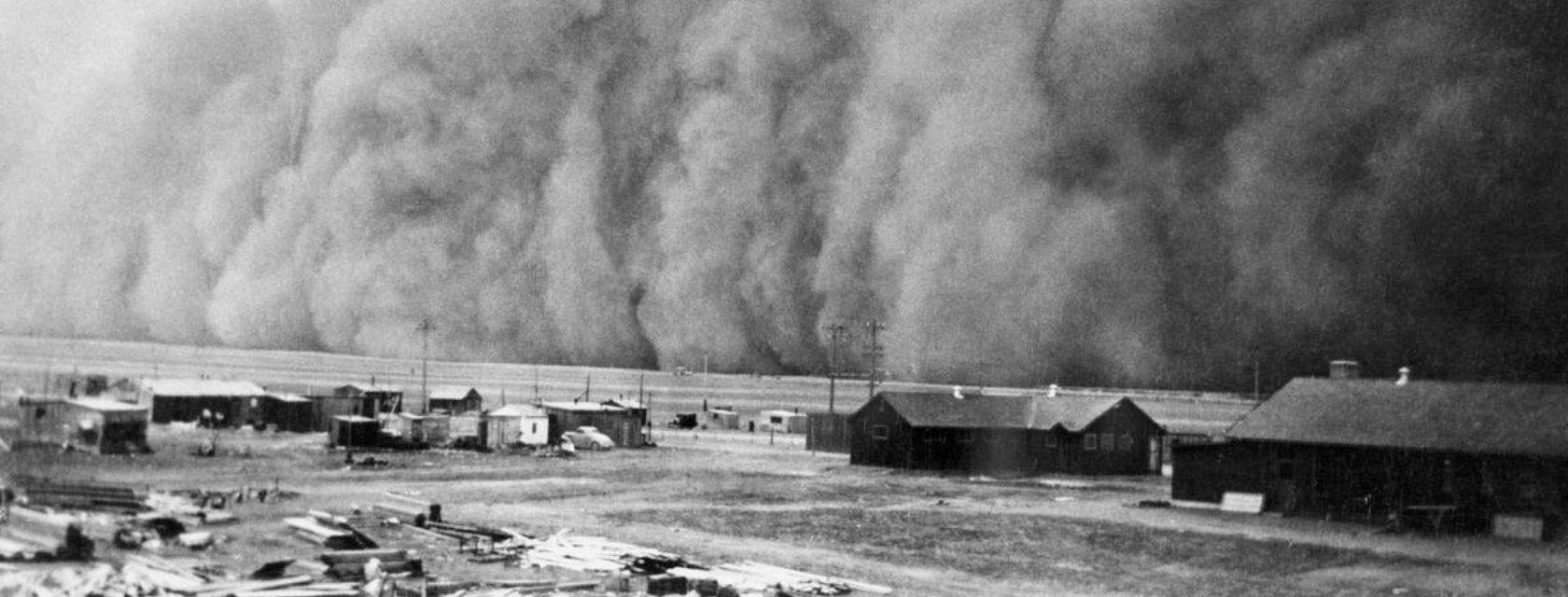
For those experiencing it, the crisis was horrific. Walls of dust blocked out the sun, infiltrated homes, entered lungs and even ended up in food. Crops were destroyed, livestock died and families went hungry. Hundreds of thousands in the U.S., and tens of thousands in Canada, migrated to cities to find relief and employment.
The Dirty Thirties unfolded amid a volatile mix of extreme weather, collapsing commodity prices and geopolitical instability.
The parallels to the present day are hard to ignore.
The lessons from the Dust Bowl are cautionary, but also instructive. The Dirty Thirties resulted in innovations that included social safety nets for farmers and technological advancements.
“One of the key lessons of the Dust Bowl is that, proactively and constructively, a combination of community mobilization and government support can help people survive,” Fraser says. “If we get ahead of this curve, if we do the work now to prepare, then we will be okay.”
As Canada works to get a handle on food sovereignty under the threat of war and uncertainty, there are current opportunities to embrace innovation and make our country a global food superpower.
Dust Bowl Blues can be heard on the CBC Ideas website.
Contact:
Arrell Food Institute
afiinfo@uoguelph.ca